

close
Choose Your Site
Global
Social Media
Views: 0 Author: Site Editor Publish Time: 2026-02-25 Origin: Site


If you work with water service connections—municipal distribution, property service lines, or utility maintenance—you’ve probably heard the term corporation stops (often shortened to “corp stops”). It’s a small component with a big job: it creates the controlled connection point between a water main and an individual service line, so a property can be supplied, isolated, or serviced without disrupting the entire main. From our manufacturing and application conversations, we’ve learned that many purchasing teams initially treat a corporation stop like “just another valve.” But in real projects, it sits in one of the most demanding positions in the system: close to the main, under pressure, often underground, and expected to remain reliable over a long service life.
At Ninghai Raising Copper Industry Co., Ltd., we view corporation stops as a practical, engineering-driven product. Your selection should be based on how the connection is made, what pipe and thread standards you use, how the site is installed, and how the service will be maintained. In this guide, we’ll explain what corporation stops are, where they are used, the common types and connection styles, and how to specify them correctly so your project avoids leaks, mismatches, and unnecessary rework.
A corporation stop is commonly installed at the water main to:
Start or shut off the flow to a specific service line
Connect a new service line to a pressurized main (using approved tapping methods)
Provide a control point for maintenance, repair, or replacement of downstream components
Support utility operations like commissioning, isolation, and service change-outs
In many systems, it acts as the first control valve on the service line right off the main. Because it is often buried and not frequently accessed, reliability and correct installation matter.
A typical water service connection can include several components, and the corporation stop plays a specific role.
Water main
Corporation stop (installed into the main or into a service saddle)
Service line (copper tube, PE pipe, etc.)
Curb stop / curb valve (often near property boundary)
Meter / meter setter
Building plumbing
Why this matters: corporation stops are selected not only for the main side, but also for compatibility with the service line material and connection style used downstream.
Different utilities and markets standardize differently, but most corporation stops fall into a few practical categories:
Ball-style designs are commonly chosen for smooth operation and clear open/close behavior. They are widely used where repeatable operation is important.
Some markets use plug/key-style designs that match traditional utility practices and existing tooling habits. These designs are often selected based on local standardization, training, and replacement compatibility.
In some industrial water systems, the term “corp stop” may also appear in chemical feed or injection assemblies. These are purpose-built variants and not the same as the standard waterworks service connection product. If your project is municipal water service, your specification should clearly state you need a waterworks corporation stop for service line connection.
Corporation stops are commonly installed by methods that allow connection to a pressurized main:
The main is drilled and tapped to create threads, then the corporation stop is installed into the threaded opening. This method depends heavily on pipe material, tapping practice, and standards.
A service saddle wraps around the pipe and provides the threaded outlet for the corporation stop and tapping process. This approach is often used when pipe material or utility practice favors a saddle method.
Buyer takeaway: You should confirm whether the project uses direct tap or saddle tap, because it affects inlet thread requirements, installation tooling, and compatibility expectations.
Corporation stops are selected by both the inlet (main side) and outlet (service line side). Common variations include:
Utility-standard corporation threads (often tied to local waterworks standards)
NPT-based options depending on region and legacy equipment
NPT styles
Flare or compression styles
Service connection options matched to CTS copper tubing or PE service pipe
Because naming varies by region, the safest procurement approach is to specify:
Nominal size
Inlet standard (utility thread requirement)
Outlet connection type (compression / NPT / etc.)
Service line material and OD standard (e.g., CTS)
Corporation stops are commonly produced in copper alloy materials designed for water service environments. Selection depends on:
corrosion resistance expectations
local standards and regulations
underground service conditions
long-term sealing stability requirements
What we recommend as a buyer habit: align material selection with your utility specification (including any lead-free requirements, if applicable in your market) and ensure your supplier can provide consistent documentation for compliance.
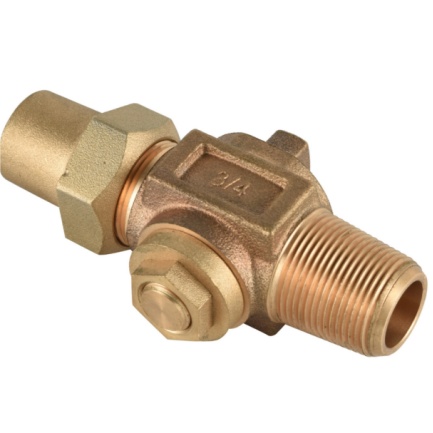
When a component is buried and expected to perform reliably, details matter more than marketing. Practical features to evaluate include:
A corporation stop must maintain sealing integrity under pressure and through temperature changes and soil conditions. Look for stable sealing structure and consistent machining quality.
Improper wrenching can distort valve bodies. A good design includes clear wrenching flats and robust body geometry for installation handling.
Thread mismatch is one of the most common causes of field problems. Precision is especially important because service connections are often installed quickly and then buried.
Even if a corporation stop is “usually operated rarely,” it must still operate when needed—during a repair, leak event, or service modification.
What you need to confirm | Why it matters | What to specify clearly |
Installation method | Affects inlet requirements | Direct tap vs service saddle |
Main pipe material/size | Determines tapping approach | Main size + pipe type |
Outlet connection style | Prevents service line mismatch | Compression / NPT / flare + size |
Service line material | Ensures correct fit | Copper CTS vs PE vs other |
Underground conditions | Impacts material choice | Corrosion environment, standards |
Compliance requirements | Supports approvals and audits | Material, test, and documentation needs |
A corporation stop is often described in short form (for example: “3/4 corp stop”), but in purchasing practice, that’s not enough. A safer ordering method is to confirm:
inlet standard and size
outlet type and size
service line OD standard (if compression)
operating style preference (ball vs plug/key)
packaging and traceability expectations for distribution
This prevents the most common procurement issue: receiving parts that are “almost right,” but not compatible with the field connection.
Different thread standards and outlet connections can look similar but are not interchangeable in the field.
Compression designs must match the service pipe OD standard. A mismatch can lead to leakage, rework, and wasted labor.
Using the wrong wrench or applying force in the wrong location can cause distortion. Good practice starts with selecting a product designed for stable wrenching.
Even though access is limited, planning for serviceability, documentation, and consistent lot traceability reduces long-term risk for utilities and contractors.
So, what are corporation stops? They are specialized stop valves used at the water main to create and control the connection between the main and an individual service line—supporting reliable installation, isolation, and maintenance of water services. The right corporation stop selection depends on more than nominal size: you must align inlet standard, outlet connection type, service line material/OD standard, installation method, and compliance requirements. When those details match, the result is a service connection that installs cleanly, reduces leakage risk, and supports long-term underground reliability.
To learn more about corporation stop configurations, material options, and how to specify a reliable standard for your project, you’re welcome to contact Ninghai Raising Copper Industry Co., Ltd. for more information.
Corporation stops are used to connect and control the service line off a water main, allowing a specific service to be supplied or isolated without affecting the entire main.
No. Corporation stops are installed at or near the main connection point, while curb stops are typically located closer to the property line for accessible shutoff.
Confirm the inlet standard (main side), then choose the outlet connection that matches your service line material and OD standard (for compression connections).
Common causes include thread mismatches, incorrect outlet connection selection, improper installation handling, and pipe/OD mismatch in compression fittings.


