

close
Choose Your Site
Global
Social Media
Views: 0 Author: Site Editor Publish Time: 2026-03-04 Origin: Site


If you work with water service lines—even occasionally—you’ve probably heard someone say, “We just need a corporation stop,” as if it’s one universal part. In reality, corporation stops come in multiple sizes and connection styles, and the “right size” depends on more than a single number. One project might specify 3/4", another might call for 1", and yet another might mention CTS O.D. compression, copper flare, or AWWA taper thread—all while still using the same general name: corporation stop.
From our perspective at Ninghai Raising Copper Industry Co., Ltd., the most common sizing confusion happens because people mix up three different “sizes” that can all apply to one corporation stop:
Inlet size (the side that threads/taps into the main or saddle)
Outlet size (the side that connects to the service line)
Service size / tubing O.D. (what the outlet must match, often CTS O.D.)
So, what size are corporation stops? The short answer: the most common inlet sizes are 1/2", 3/4", and 1" in many AWWA-style waterworks applications, but larger sizes exist depending on system design and standards.
The useful answer: you should size the corporation stop by matching (a) the main tap/inlet spec and (b) the service line outlet connection—not by guessing one number.
In this guide, we’ll break down corporation stop sizes in a way that’s easy to apply in procurement and installation: common size ranges, inlet vs outlet sizing, typical connection formats, and a practical checklist that prevents ordering mistakes.
A corporation stop is typically the first control valve off the water main for a service line, allowing installation and control of the service connection without shutting down the main.
Because it sits at the start of the service connection, it must match both the main tapping requirement and the service line connection requirement.
When someone asks, “What size are corporation stops?” they may mean one of these:
Inlet size (e.g., 1/2", 3/4", 1")
Outlet size (often sized to tubing O.D., flare thread, MIP/FIP, or compression format)
Overall service size (the service line size the fitting is intended for)
That’s why you’ll often see product naming that looks like:
3/4" AWWA x 1" compression or 1/2" AWWA x 5/8" CB, where one side is the inlet and the other side is the outlet.
In many waterworks systems, corporation stops follow AWWA-style sizing. Common inlet sizes frequently include 1/2", 3/4", and 1", with larger sizes also used depending on design.
Here’s what you’ll commonly see in catalogs and specifications:
A broad range of inlet sizes may be available, including 1/2, 5/8, 3/4, 1, 1-1/4, 1-1/2, and 2 inches (availability depends on design type and system standards).
Some AWWA plug-style corporation stops are specified for operating pressure (e.g., 100 psi on smaller sizes and different ratings for larger sizes), which also illustrates that “size families” matter in standards-based projects.
Practical takeaway:
If your drawing/spec says AWWA taper thread and an inlet size (like 3/4" or 1"), treat that as the primary “corporation stop size” for the main connection—then choose an outlet connection that matches the service tubing/pipe.
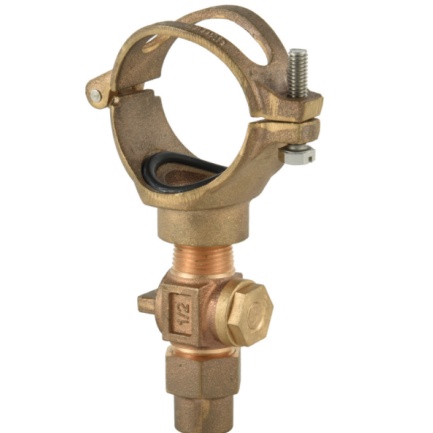
The outlet is where corporation stop sizing becomes “project-specific,” because service lines can be connected in several ways:
CTS O.D. compression connections (very common in service tubing)
Copper flare thread outlets (common for copper service connections)
MIP / FIP outlets (threaded pipe connections)
Many waterworks service fittings reference CTS O.D. (Copper Tube Size outside diameter) because the compression connection is designed around the tube’s outside diameter rather than a pipe’s nominal size. You’ll see catalog language like “compression connection for CTS O.D. tubing.”
Why it matters:
Two products might both be called “3/4-inch corporation stop,” but one has an outlet meant for 3/4 CTS O.D. tubing, while another uses a flare or threaded outlet. Those are not interchangeable without adapters—and adapters can add leak points and installation time.
When reviewing a corporation stop spec, read it like this:
[Inlet size + inlet standard] × [Outlet connection + outlet size]
Here’s a practical table that shows how to interpret the common ways corporation stops are presented:
Spec Style You See | What It Means | What You Should Confirm |
3/4" AWWA × CTS Compression | AWWA-style inlet for main tapping, compression outlet for CTS O.D. tubing | Confirm CTS O.D. tubing size & compression type |
1" × 3/4" CC × Compression | One-inch inlet/service designation with compression outlet format | Confirm inlet spec + exact outlet size format |
1/2" AWWA × 5/8" CB | AWWA inlet size plus a specific outlet standard/size format in catalog style | Confirm what “CB” refers to in that catalog context |
AWWA inlet × MIP outlet | Main connection is AWWA taper; outlet is male pipe thread | Confirm thread standard and downstream fitting |
(Manufacturers label slightly differently, but the logic is the same: inlet spec + outlet spec.)
While project specs vary by region and utility standards, the most frequently encountered sizes in many water service applications tend to center around:
Inlet sizes: 1/2", 3/4", 1"
Outlet connections: CTS O.D. compression, copper flare, or threaded (MIP/FIP) depending on the service line design
Larger corporation stop families also exist (such as ball-type designs offered in larger sizes in some catalogs), often selected for higher flow service lines or specialized installations.
When we help buyers avoid sizing errors, we recommend confirming these five points before ordering:
Main connection requirement
Is the inlet AWWA taper thread? saddle? tapping spec? (confirm the standard and nominal inlet size)
Service line material + sizing convention
Are you connecting to copper tube (CTS O.D.), PE service line, or threaded pipe?
Do you need compression for CTS O.D. tubing?
Outlet connection type
Compression vs flare vs MIP/FIP
Confirm outlet size matches your service line specification (not just “about 3/4”)
Operating pressure and application constraints
Some designs specify pressure limits by size and type; confirm project requirement aligns.
Installation workflow
Which tapping/drilling machine or adapter is used? Some catalogs include adapter guidance by size/configuration.
Use this table as a practical starting point for discussion with your installer or engineer:
If your project is… | You usually start by confirming… | Then choose outlet based on… |
Standard service connection off main | Inlet size (often 1/2", 3/4", 1") and inlet standard (AWWA taper) | CTS O.D. compression or flare/thread style required |
Larger service line / higher flow | Larger inlet size availability and design type | Compression size range and service tubing O.D. |
Utility has strict catalog spec | Exact model style + standard language | Exact outlet connection spec |
This keeps your ordering conversation structured: inlet first, outlet second, verify standards throughout.
So, what size are corporation stops? In waterworks practice, corporation stops are commonly available in inlet sizes such as 1/2", 3/4", and 1", with additional larger sizes depending on design families and utility standards. But the most important point is that corporation stop “size” is really two specs: the inlet size/standard for the main, and the outlet connection type/size for the service line—often referencing CTS O.D. compression, flare, or threaded connections.
At Ninghai Raising Copper Industry Co., Ltd., we work with buyers who need dependable service brass components and clear sizing support—from matching inlet standards to selecting the right outlet for the service line. If you’re preparing a project list or confirming corporation stop sizes for procurement, you’re welcome to learn more and contact Ninghai Raising Copper Industry Co., Ltd. for product information and selection guidance.
Many projects commonly use 1/2", 3/4", and 1" inlet sizes, but availability depends on standards and design families.
Because one is the inlet size (main connection) and the other is the outlet size/connection for the service line (compression, flare, or thread).
It indicates the outlet compression connection is designed for Copper Tube Size outside diameter tubing, which must match the service tube O.D. spec.
Adapters can work, but they may add leak points and installation complexity. It’s usually better to select a corporation stop with the correct outlet connection from the start.


