

close
Choose Your Site
Global
Social Media
Views: 0 Author: Site Editor Publish Time: 2026-03-11 Origin: Site


If you’re searching “Where is the corporation stop located?” you’re probably dealing with a real-world job: a new water service connection, a repair, a meter pit layout, or a municipal specification that mentions corp stops and you want to understand exactly where this valve sits in the system.
From our perspective as a manufacturer of brass/copper alloy waterworks components, a corporation stop is not a “mystery part.” It has a clear position and a clear role. In most municipal water service layouts, the corporation stop is installed at the water main connection—it is commonly described as the first valve off the main, controlling flow from the distribution main into the service line.
In this article, we’ll explain where a corporation stop is located, how to find it in typical service line layouts, how it differs from a curb stop, and what buyers should confirm when specifying corporation stops for projects. We’ll keep the focus on practical procurement and field clarity (not step-by-step installation).
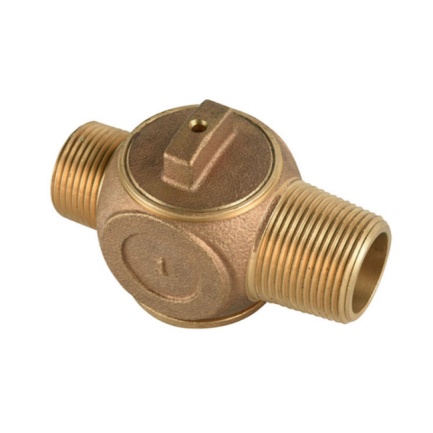
A corporation stop (often called a corp stop) is a small shutoff valve used to connect a service line to a water main, and to control flow at that connection point. It’s widely described as the initial control valve on the service line—meaning it’s the first valve right after the main.
Many specs also define it as the fitting/valve inserted into the distribution main to which the service pipe is attached.
In most water distribution systems, the corporation stop is located at the water main, right where the service line branches off the main (often underground). It is typically installed as part of the tapping connection that creates the service.
Think of a typical water service line as a chain starting from the street main and ending at the building. The corporation stop is located at the very beginning of that chain:
Street water main
Corporation stop (at the main tap connection)
Service line running toward the property
Curb stop (usually near property line or meter pit, depending on local practice)
Meter / meter setter (varies by region and project)
Building shutoff inside/near the structure
Many utility specifications require both a corporation stop and a curb stop on the service line.
Here’s a simplified map that procurement teams often use when reviewing drawings or writing purchase orders:
Component | Typical Location | Primary Purpose |
Water main | Street/main line | Supply for distribution |
Corporation stop | At the main tap connection | First shutoff/control from main to service |
Service line | Underground route to property | Delivers water from main to user |
Curb stop | Near property line / curb box area (varies) | Convenient shutoff point for service control |
Meter system | Meter pit / building entry (varies) | Measurement and account control |
This is why the corporation stop is often discussed together with “tapping” operations: it’s tied to the connection method used to create the service line branch from the main.
This is one of the most common sources of confusion—especially for buyers new to municipal waterworks terminology.
Location: at the water main connection
Access: usually underground; accessed during construction, repairs, or specialized maintenance
Role: “first valve off the main”
Location: typically along the service line nearer the property boundary or curb box area (layout depends on local utility standards)
Access: designed to be reachable via a curb box/key from grade for operational shutoff
Practical takeaway for buyers:
If a spec calls for a corporation stop, it generally means the valve intended for the main-to-service connection, not the customer-side shutoff.
When buyers order “corporation stops” without defining the application, mistakes happen. The valve’s location at the main connection drives key requirements:
Connection standard and inlet/outlet type
Many specifications require specific inlet threads or standards at the main side and specific service line outlet connections (compression, flare, etc.).
Material expectations
Because the corporation stop is installed underground and expected to perform reliably over time, utilities commonly specify durable materials such as brass/bronze and require corrosion resistance appropriate to the environment.
Pressure and operating expectations
Because it’s the first valve off the main, buyers often need to confirm the pressure rating and operating head style consistent with local tools and practice.
Installation method compatibility
Some systems use saddle tapping or related methods where the corporation stop interfaces with tapping equipment and adapters during service creation.
When you’re reviewing a municipal plan set, a tender document, or a utility standard detail, the quickest way to locate the corporation stop is to look for the service connection point on the water main. In most drawings, the corporation stop is shown right on the main line, exactly where the service line branches off. It is commonly labeled using shorthand terms such as “Corp stop,” “Corporation stop,” “Corporation valve,” and in some specifications you may also see “Main stop” or “Service tap valve.” These labels can vary by region, engineer, or utility template, so it helps to scan both the plan view notes and the typical detail sheets.
A practical tip is to follow the service line from the building side backward. You will often see a meter or meter setter, then a shutoff closer to the property line (often the curb stop), and finally the point where the service connects to the main. That last connection point is where the corporation stop is typically located. If you see a valve symbol inside a curb box near the sidewalk or property boundary, it’s usually the curb stop, not the corporation stop. The corporation stop is usually not placed for “easy daily access” from grade—it’s positioned at the main to control flow into the service connection.
From a supplier viewpoint, most wrong-shipments happen because a purchase order lists only “corporation stop” without the full connection and standard details. To prevent that, confirm the following before ordering:
Size
This is usually tied to the service line size (for example 1/2", 3/4", 1"), but always match the project spec.
Inlet standard required by the utility/spec
Different municipalities and projects specify different inlet thread types or standards at the main connection. This is a critical point.
Outlet connection type
Confirm whether the service side requires compression, flare, pack joint, or other connection styles—this is often where mismatches occur.
Operating style
Specify the key/head style expected by local tools and maintenance practices.
Material requirement
Confirm brass/bronze grade and whether lead-free compliance is required for the jurisdiction.
Quantity and packing
Project workflow matters—bulk packing versus individually packed items can affect site handling and inventory control.
Clear specs help avoid the classic procurement problem: you bought the right valve name, but the wrong ends.
Even though the corporation stop may not be operated frequently after installation, it’s still a critical control point. Many sources describe its purpose as enabling service line installation/connection without interrupting main pressure, and as the first control valve off the main.
From a purchasing and reliability standpoint, the value is straightforward:
It supports standardized service tap layouts
It provides a defined control point at the main
It matches established tools and municipal practices
So, where is the corporation stop located? In typical water service line systems, it’s located at the water main connection, serving as the first valve off the main that controls flow into the service line. Understanding that location makes it much easier to read specifications, avoid mixing it up with the curb stop, and purchase the correct inlet/outlet configuration for your project.
At Ninghai Raising Copper Industry Co., Ltd., we support waterworks buyers with corporation stop solutions designed for real municipal and project requirements—clear specifications, consistent production quality, and practical configuration options for different service connections. If you’re sourcing corporation stops for a new installation or an ongoing replacement program, you’re welcome to learn more through Ninghai Raising Copper Industry Co., Ltd. and contact our team for product details and selection support.
It is typically located at the water main, at the point where the service line is connected—often described as the first valve off the main.
No. A corporation stop is at the main connection; a curb stop is usually positioned farther along the service line for convenient access and shutoff.
Many utility standards require both so the system has a control point at the main connection and an accessible shutoff point along the service line.
Include size, inlet/outlet connection type, operating style, material requirement, and any utility standard references to ensure a correct match to the service tap design.


