

close
Choose Your Site
Global
Social Media
Views: 0 Author: Site Editor Publish Time: 2026-08-01 Origin: Site


The invisible infrastructure beneath our streets keeps modern municipalities running smoothly. Municipal engineers and plumbing contractors rely on precision when designing these critical water service lines. Incorrectly specifying water service valves causes severe headaches on the job site. Municipal code violations, failed inspections, and costly excavations routinely plague unprepared procurement managers. Understanding the precise functional boundaries between the water main and the property line is essential. This knowledge guarantees strict compliance and preserves long-term system integrity.
We will clarify the structural, functional, and legal differences separating these essential valves. You will discover how they operate in the field and why adhering to local compliance matters immensely. We highlight common installation pitfalls and explore specialized industrial applications. This guide provides a comprehensive technical baseline. You can use it for specifying the correct hardware for both municipal and industrial service laterals.
Decision-makers must establish exactly where municipal liability ends and private property begins. This operational boundary ensures correct product selection during the procurement stage. Utility providers handle the street-level infrastructure. Private owners manage the plumbing running into their buildings. Placing the right valve in the correct location defines this division of responsibility.
The primary control valve tapping directly into the municipal water main serves a singular purpose. The city or utility provider strictly controls this critical junction. Utility crews install these valves directly into the active, pressurized street pipe. They rarely touch them again after the initial tap.
A unique characteristic defines their operation. Engineers design them to operate as completely open valves. They continuously feed pressurized water into the service lateral. Utility crews do not use them for routine shut-off tasks. If a Corporation Stops fails, the city must excavate the street to replace it.
The secondary valve sits securely at the right-of-way or property line. We commonly refer to this location as the "curb". This valve acts as the official transition point separating public utility liability from private ownership.
Municipal workers and licensed plumbers use this valve frequently. It allows them to isolate water flow to a specific property. They can perform this action without disrupting the primary municipal main. Manufacturers design them specifically for periodic use. Plumbers shut off the water here for interior pipe repairs. Cities also use this control point to halt service for non-payment.
You must evaluate the physical and mechanical differences between these valves carefully. Mismatched fittings cause major delays during installation. We provide a detailed breakdown of their components to help you avoid procurement errors.
| Feature | Corporation Stop | Curb Stop |
|---|---|---|
| Primary Location | Directly on the municipal water main | At the property line (the curb) |
| Inlet Threading | AWWA/CC taper or specialized Iron Pipe thread | Standard compression, flare, or NPT |
| Installation Status | Wet-tapped under live street pressure | Installed inline on a depressurized pipe |
| Accessibility | Directly buried; requires excavation to access | Surface accessible via a vertical curb box |
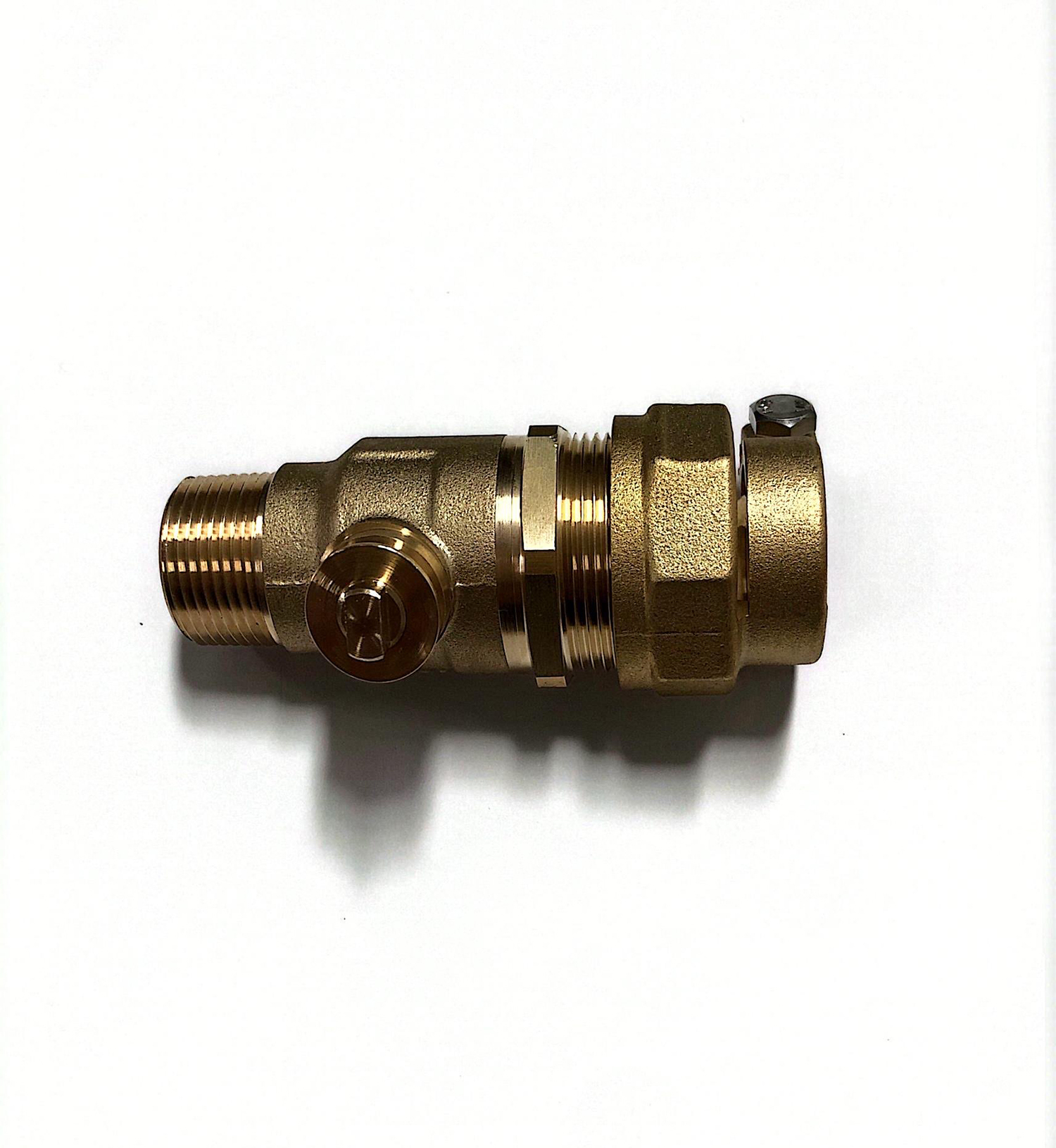
The inlet thread separates these two components dramatically. Corporation Stops feature an inlet thread designed exclusively for thick water mains. They often use an AWWA/CC taper thread or a specific Iron Pipe thread. The steep taper bites into the main pipe wall. This creates a secure, leak-proof seal under intense pressure. The outlet connects to the service line material. Common service lines include copper tubing, PEX, or heavy-duty poly pipe.
Curb stops operate differently. They feature matching inlet and outlet connections. These connections correspond directly to the chosen service line material. A curb stop might feature compression fittings on both ends to connect two sections of PEX tubing securely.
Installation environments differ drastically. Crews install main taps under active pressure. They use a specialized tapping tool and a brass saddle. The tapping machine drills into the live main. It threads the valve into place simultaneously. Crews then bury the valve directly in the trench bedding.
Crews install the property-line valve on a depressurized pipe segment. A vertical sleeve, known as a "curb box", accompanies this valve. This cast-iron or plastic sleeve extends upward to the surface. It allows a specialized wrench to reach deep down. Workers can easily turn the valve actuator from the street level.
Both devices generally utilize a robust ball valve or plug valve design. They turn ninety degrees to open or close the water flow. However, main tap valves often require a highly specific, low-profile operating head. This compact design allows the valve to fit perfectly inside tight tapping machine housings during the wet-tap procedure.
Purchasing non-compliant plumbing hardware guarantees a swift inspection failure. You must frame your entire selection criteria around verified industry standards. Understanding the legal landscape protects your project timeline.
Federal Lead-Free Mandates: The federal government strictly regulates drinking water components. You must source "NL" (No-Lead) brass for all potable water applications. The Safe Drinking Water Act mandates this requirement across the country. Check your valve specifications carefully. They must comply directly with NSF/ANSI 61 and NSF/ANSI 372 standards. An inspector will reject standard leaded brass instantly.
AWWA C800 Standard: Specifiers must verify AWWA C800 compliance before ordering materials. The American Water Works Association created this vital framework. It dictates the exact performance metrics required for underground service lines. It governs thread specifications, pressure ratings, and allowable material composition. AWWA C800 ensures the hardware can survive decades buried underground safely.
Local Municipal Variance: Local city codes always supersede general national guidelines. You cannot ignore regional requirements. Specific cities often mandate highly specific thread types based on local soil conditions. They might dictate exact curb box dimensions based on the regional frost line. Always verify regional codes before placing a bulk order.
Industrial buyers expand the scope far beyond basic municipal drinking water. Chemical manufacturing plants and cooling towers require highly specialized fluid control. Evaluating valves for chemical injection changes the procurement rules entirely.
Industrial facilities utilize pressurized fluid systems daily. Water treatment plants inject harsh chemicals directly into large process pipes. They inject liquid chlorine to sanitize drinking water. They inject anti-scalants into industrial cooling towers. Plant engineers use Corporation Stops to facilitate this chemical feed process. The valve allows the injection quill to enter the pressurized main safely. Operators can remove the injection equipment for maintenance without shutting down the entire plant.
Standard no-lead brass works perfectly for tap water. It fails rapidly in corrosive industrial environments. Chemical engineers must shift their material evaluation strategies. They specify PVC or CPVC materials for acidic fluid lines. They utilize stainless steel variants to resist severe chemical corrosion. You must base your material selection on strict fluid compatibility charts. You also need to verify the specific system pressure constraints before installing non-brass components.
Operational expertise requires understanding common implementation traps. Field technicians face daily challenges when burying municipal infrastructure. The right hardware choices effectively mitigate these recurring risks.
Site workers face a notoriously common field issue during excavation. The vertical sleeve often shifts laterally during the trench backfilling process. Heavy dirt pushes the sleeve off its center axis. This misalignment makes it completely impossible to drop a wrench onto the valve below. Proper trench bedding prevents this issue entirely. Workers must utilize solid base supports. They must compact the soil evenly around the vertical sleeve.
Plumbers face severe risks when connecting mismatched metals underground. Connecting a brass valve directly to an older galvanized steel pipe triggers a chemical reaction. Galvanic corrosion aggressively eats away the steel pipe threads. The connection eventually fails and causes a massive underground leak. Plumbers prevent this disaster by installing proper dielectric protection. Dielectric unions isolate the two distinct metals electrically.
Field crews must verify thread tapers before drilling the main. Forcing the wrong thread type into the street pipe invites disaster. An AWWA thread differs greatly from a standard NPT thread. Forcing an NPT thread into an AWWA-tapped saddle strips the brass threads immediately. In worst-case scenarios, the immense force fractures the municipal main line. A fractured water main floods the street and costs thousands to repair.
A straightforward framework helps buyers organize their purchase orders efficiently. You need accurate quotes from suppliers. Use this specific checklist to capture every required technical detail before submitting your request.
Following this checklist eliminates costly return shipping fees. It prevents contractors from stalling on the job site while waiting for replacement parts. Precision in procurement translates directly to efficiency in the trench.
Understanding underground fluid control requires recognizing distinct operational boundaries. Main tap valves serve as the highly pressurized starting point of any service line. They remain buried, fully open, and strictly under municipal control. Conversely, valves located at the property line act as accessible gatekeepers. They grant plumbers and utility workers the ability to isolate specific buildings easily.
Validating your local municipal codes remains a non-negotiable requirement. You must confirm AWWA C800 standards before finalizing any purchase order. Ignoring these standards leads to failed site inspections and wasted municipal resources. Federal lead-free mandates strictly dictate your material choices for drinking water.
Take action today to streamline your next infrastructure project. Consult directly with technical sales representatives to verify your regional thread requirements. View your supplier’s updated product catalog to identify verified compliant valves. Download a technical spec-sheet comparison guide to ensure your next installation proceeds flawlessly.
A: No. They lack the specific inlet threading required to tap directly into a municipal water main and are not designed to interface with pressurized tapping machines.
A: While all new corporation stops sold for potable water in the U.S. must be lead-free (NL), older inventory or industrial-grade valves meant for non-potable/chemical systems may not be. Always verify NSF/ANSI 372 compliance for drinking water.
A: Ground settling, improper backfilling, or frost heave can cause the curb box to shift off-center from the valve actuator, requiring excavation to realign before the valve can be operated.
A: A specific, steep-tapered thread (Corporation Cock thread) designed by the American Water Works Association specifically for sealing corporation stops into pressurized water mains. It is not interchangeable with standard NPT (National Pipe Thread).


