

close
Choose Your Site
Global
Social Media
Views: 0 Author: Site Editor Publish Time: 2026-09-07 Origin: Site


Are brass fittings better than copper? In many plumbing applications, especially threaded connections, compression fittings, valves, adaptors, and other precision-machined components, brass can offer practical advantages because it is strong, durable, machinable, and well suited to complex connection geometries. Copper fittings, however, remain an excellent choice for soldered, brazed, and press-connected copper piping systems where simplicity, corrosion resistance, thermal performance, and material compatibility are priorities.
The most accurate answer is therefore not that brass is universally better than copper. Brass and copper fittings solve somewhat different plumbing problems, and modern water systems frequently use both materials together. Copper tube and copper fittings are commonly used to transport water through the piping network, while brass components are widely used at valves, threaded transitions, meter connections, compression joints, adaptors, and other locations where additional mechanical strength or machining complexity is useful.
The Copper Development Association recognizes a broad range of copper and copper-alloy fittings for plumbing applications, including wrought copper solder fittings, cast copper-alloy fittings, threaded fittings, flared connections, press fittings, and brazed fittings. This illustrates an important point for buyers: material selection should be considered together with the connection type, operating conditions, applicable standard, and system design, rather than choosing a metal based on one property alone.
Ninghai Raising Copper Industry Co., Ltd. manufactures brass and bronze valves, pipe fittings, water-meter accessories, corporation stops, and related copper-alloy plumbing products. The company states that it was established in 2002 and integrates design, R&D, manufacturing, testing, sales, and service.
Buyers looking specifically for plumbing connections can review Raising's Brass Fitting Collection.
For most buyers, the difference can be summarized this way:
Factor | Brass Fittings | Copper Fittings |
|---|---|---|
Mechanical Strength | Generally higher and harder | Softer and more ductile |
Machinability | Excellent | More difficult to machine |
Threaded Connections | Excellent | Less commonly preferred for complex threads |
Compression Connections | Very common | Available depending on system |
Soldered Connections | Possible with suitable design | Very common |
Press Connections | Available in copper-alloy systems | Very common in copper piping |
Corrosion Resistance | Very good with correct alloy | Very good in suitable water conditions |
Dezincification Risk | Possible in susceptible brass alloys | No dezincification because copper contains no zinc |
Complex Valve/Fitting Shapes | Excellent | Less convenient for precision machining |
Thermal Conductivity | Good | Excellent |
Reusable Mechanical Connections | Often practical | Depends on connection type |
Typical Use | Valves, adaptors, threaded fittings, compression fittings | Elbows, tees, couplings, tubing systems |
The better fitting is the one that matches the application.
Copper is an elemental metal, while brass is a copper-based alloy containing zinc as a principal alloying element.
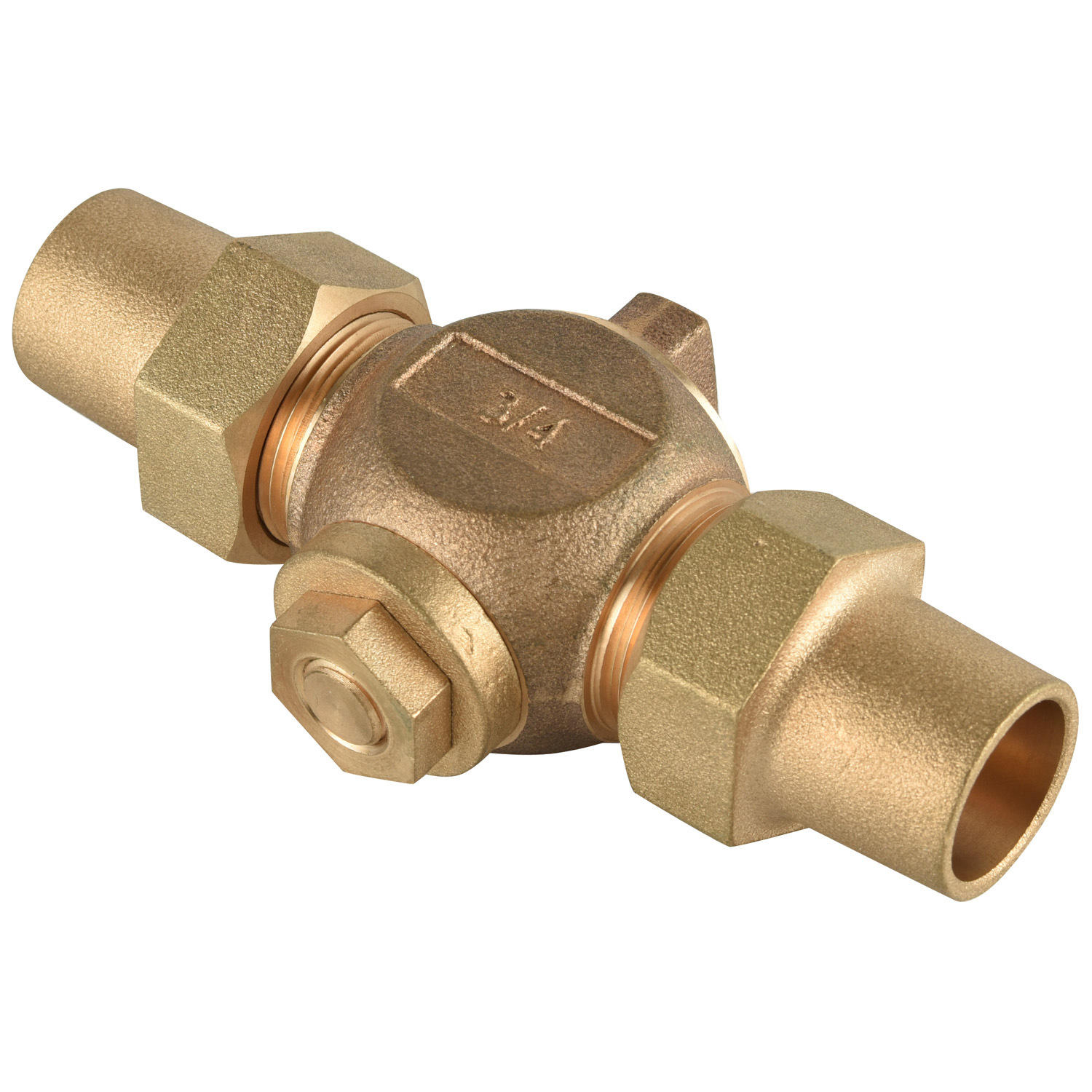
Adding zinc and other alloying elements changes the properties of copper considerably. Compared with relatively pure copper, many brass grades become:
Harder
Stronger
Easier to machine
Better suited to threads
More wear resistant
More dimensionally stable during machining
These characteristics explain why brass is widely used for valves, threaded adaptors, compression fittings, connectors, meter couplings, and other components containing relatively complicated geometries.
Copper, by comparison, has excellent ductility and thermal conductivity and can be readily formed into tube and relatively simple fittings. This makes copper highly effective for continuous piping systems.
That difference is one reason plumbing systems often combine the materials rather than choosing only one.
A plumbing fitting frequently needs to do more than change the direction of a pipe.
It may need to:
Accept male or female threads
Compress a pipe mechanically
Hold a valve mechanism
Connect different pipe materials
Accept a flare nut
Create a removable joint
Withstand installation torque
Provide accurate sealing surfaces
Brass is well suited to these functions because it can be forged, machined, drilled, threaded, and finished to relatively precise tolerances.
Raising's current Brass Fitting range includes inserts, adaptors, water-meter connections, compression fittings, cartridges, and related components designed for water and piping applications.
In general, commonly used plumbing brass alloys are harder and mechanically stronger than relatively pure copper.
This matters when the fitting experiences:
Thread engagement
Installation torque
Mechanical loading
Repeated disassembly
Compression forces
Valve operation
A threaded fitting needs to retain its geometry when a wrench applies torque. Brass is particularly useful in this type of application because it combines mechanical strength with excellent machinability.
Copper's softness and ductility are advantageous for tubing and forming but are not always ideal when a component requires complex, durable threaded features.
This is why brass is commonly found in valves, adaptors, unions, compression connections, and threaded interfaces.
Threading is one of the strongest reasons to specify brass.
Brass machines cleanly and can produce precise male and female threads, making it useful for BSP, NPT, and other plumbing connections.
For example, Raising's Brass Shower Faucet Fittings NR-I033 are available with BSP or NPT threaded connections and use forged-and-machined brass construction. The published product specification lists multiple material options including CW617N, HPB59-1, DZR CW602N, and lead-free brass grades.
Threaded brass components are particularly useful where connections may need to be installed or serviced without soldering.

Copper remains particularly strong in conventional copper-tube plumbing systems.
According to Copper Development Association technical guidance, soldering with capillary fittings has historically been one of the most common methods for joining copper tubing. Wrought copper and copper-alloy pressure fittings are produced under standards such as ASME B16.22, while other standards cover cast fittings, threaded fittings, brazed systems, drainage fittings, and press connections.
A typical copper water line might use:
Copper tube
Copper elbows
Copper tees
Copper couplings
Brass valves
Brass threaded adaptors
That combination uses each material where its characteristics provide the greatest value.
Both materials can provide long service lives in properly designed water systems, but their corrosion mechanisms differ.
Copper naturally develops surface films that can protect the underlying metal in many water environments. However, copper is not immune to corrosion. Water chemistry, velocity, temperature, dissolved gases, and installation conditions can contribute to pitting or erosion-related problems.
Brass also provides good corrosion resistance, but because it contains zinc, certain brass alloys can be susceptible to dezincification.
Dezincification is a corrosion mechanism in which zinc is preferentially removed from brass.
As zinc leaves the alloy, the affected area can become more copper-rich and porous, potentially reducing mechanical strength.
Research into potable-water plumbing has identified dezincification as one of the important non-uniform corrosion mechanisms affecting certain brass devices.
The risk depends on factors such as:
Brass alloy
Zinc content
Water chemistry
Chloride concentration
Temperature
Flow conditions
Time
This does not mean brass should be avoided. It means the correct brass grade needs to be selected for the intended water conditions.
DZR means dezincification-resistant brass.
These alloys are formulated and processed to improve resistance to selective zinc removal in aggressive water conditions.
DZR brass can be especially relevant for:
Potable water systems
Hot-water systems
Areas with aggressive water chemistry
Long-service plumbing components
Valves and fittings that are difficult to replace
Raising lists DZR CW602N among the material options for several of its brass plumbing products, along with other conventional and lead-free brass grades. For example, its BS EN 1213 Brass Stop Valve NR-S002 lists CW617N, HPB59-1, DZR CW602N, and lead-free alternatives.
For procurement, specifying only “brass” is therefore insufficient. The exact alloy matters.
Yes. Brass fittings are routinely used with copper tubing when the connection method and fitting are designed for that application.
Common examples include:
Compression connections
Flare connections
Threaded adaptors
Stop valves
Water-meter connections
Isolation valves
Raising's Brass Stop Valve With Flare Copper Tube Nut NR-S003 is a direct example. Its published design incorporates a flare copper-tube nut that creates a metal-to-metal connection with copper tubing.
This type of hybrid connection is common because copper tube provides the water pathway while the brass component provides a more robust valve body and connection interface.
Brass and copper are generally considered compatible materials in many plumbing systems because brass is itself a copper-based alloy.
Research has examined galvanic interactions between brass devices and copper tubing, and brass-copper connections are common in real plumbing systems. The corrosion behavior still depends on factors such as water chemistry, flow, temperature, and the exact alloys involved.
The main material compatibility problems in plumbing often become more pronounced when copper-based components are connected with metals that are much farther apart electrochemically.
Even so, designers should always evaluate the entire system rather than assume that all mixed-metal combinations are automatically safe.
Brass is particularly common for compression connections.
A compression fitting typically relies on mechanical pressure rather than solder to seal the pipe.
Advantages can include:
No open flame
Easier installation
Faster replacement
Useful in restricted spaces
Convenient connection to different pipe materials
Brass is well suited to this application because the fitting body and threads need enough strength to tolerate tightening forces while maintaining accurate sealing geometry.
Raising manufactures products such as a Brass Elbow Compression Adaptor for PE Pipe within its brass fitting category, along with straight and female compression-related connections.
Water meters require connections that can be installed securely, serviced when necessary, and withstand continuous water pressure.
Brass is frequently used here because threaded and union-style connections benefit from its strength and machining characteristics.
Raising's Brass Water Meter Coupling NR-W005 is specified for water and non-corrosive liquids, with BSP/NPT threaded connections, 1/2-inch to 2-inch sizes, and forged-and-machined construction.
Buyers sourcing complete meter installations can also review Raising's Water Meter Fittings.
This is another area where brass typically has a practical advantage.
A valve body contains internal geometry that may include:
Seats
Threads
Stems
Sealing surfaces
Ball cavities
Cartridges
Packing structures
These features require accurate machining.
Raising supplies a broad Brass Valve Range, including ball valves and other water or gas-control components. Its wider valve portfolio also covers gate, check, stop, water-meter, and lockable valve configurations.
Copper fittings, by contrast, are more commonly used to route the pipe itself rather than contain complex valve mechanisms.
Underground service connections create another set of requirements.
These components may need to withstand:
Soil exposure
Water pressure
Mechanical installation forces
Long service periods
Difficult maintenance access
Water-service systems may therefore use copper-alloy valves and fittings such as corporation stops, curb stops, meter fittings, and service-line adaptors.
Raising's Corporation Stops range includes brass and lead-free bronze configurations for municipal and water-distribution applications.
Raising's technical article What Is the Purpose of a Corporation Stop? also explains the different roles of corporation stops and curb stops in water-service systems.
Despite the mechanical advantages of brass, copper fittings remain preferable in many situations.
When a building already uses copper tube throughout, copper elbows, tees, and couplings create a simple, consistent piping system.
Copper fittings are especially suitable where capillary soldering or brazing is already the established installation method.
CDA technical standards cover wrought copper and copper-alloy fittings for these connection methods.
Copper has substantially higher thermal conductivity than brass.
That makes copper more appropriate in applications where heat transfer is part of the component's function.
Copper does not contain zinc and therefore cannot undergo dezincification.
That does not mean it cannot corrode, but it eliminates this particular brass-specific corrosion mechanism.
Brass is often the stronger candidate when the application requires:
Threaded connections
Compression connections
Flared connections
Precision machining
Valve bodies
Meter couplings
Pipe adaptors
Repeated assembly
Higher mechanical rigidity
Its combination of strength, corrosion resistance, machinability, and connection flexibility explains why it appears throughout commercial plumbing systems.
Installation method should be one of the first selection criteria.
Installation Requirement | Typical Preferred Option |
|---|---|
Soldered copper tube | Copper fitting |
Brazed copper tube | Copper/copper-alloy fitting |
Press copper system | Approved copper/copper-alloy press fitting |
Threaded pipe connection | Brass fitting |
Compression connection | Brass commonly used |
Flare copper tube | Brass/copper-alloy fitting common |
Valve connection | Brass commonly preferred |
Removable mechanical joint | Brass often practical |
Copper Development Association guidance also notes that mechanical connections such as flared joints can be particularly useful where water cannot be completely removed from a pipe or where flame-based soldering is impractical.
The installation environment can therefore determine the fitting material before cost is even considered.
It is tempting to say brass automatically handles more pressure because it is stronger, but plumbing pressure ratings should not be determined from the base metal alone.
A fitting's allowable pressure depends on:
Alloy
Wall thickness
Geometry
Manufacturing process
Connection type
Temperature
Applicable standard
Seal design
The Copper Development Association similarly notes that system operating pressure depends not only on the tube but also on joints, valves, and other in-line components; the lowest-rated part can govern system performance.
For example, Raising's published Brass Water Meter Coupling NR-W005 lists a working pressure of 16 bar, but that specification belongs to that particular fitting design—not to every brass fitting.
Always use the actual product rating.
That depends on what “durable” means.
Against mechanical deformation and thread wear, brass usually has an advantage because it is harder.
For long straight piping and conventional capillary connections, copper has a very strong service history.
For corrosion, the outcome depends on:
Alloy
Water chemistry
Temperature
Flow velocity
Installation quality
Neither material should be described as universally longer-lasting.
A well-designed copper system can operate for decades, and correctly selected brass or DZR brass fittings can also provide long service life.
Brass mechanical fittings can be convenient when future maintenance is expected.
Threaded, compression, and flare connections can often be dismantled without cutting the entire pipe system.
This is valuable around:
Water meters
Valves
Pumps
Equipment connections
Service entrances
Soldered copper fittings create a compact permanent joint but generally require more work when the fitting itself needs to be replaced.
Serviceability should therefore be considered during design, especially for components expected to require inspection or replacement.
There is no fixed answer.
Metal prices change, and fitting cost also depends heavily on:
Alloy
Weight
Manufacturing method
Machining
Threads
Coating
Certification
Order volume
Product complexity
A simple copper elbow can cost less to manufacture than a precision-forged and CNC-machined brass adaptor.
On the other hand, comparing raw metal prices alone ignores installation time and serviceability.
A more useful calculation is:
Total Installed Cost = Fitting + Labor + Joining Materials + Installation Time + Maintenance
For industrial buyers, lifecycle cost is usually more relevant than fitting price alone.
Potable-water applications require particular attention to material specifications.
Modern plumbing projects may require lead-free brass or other compliant copper alloys depending on the destination market and applicable drinking-water regulations.
Raising's product specifications list lead-free brass options such as C46500 and CW511L on selected fittings, while DZR CW602N is also available for some products. For example, the Brass Shower Faucet Fittings NR-I033 list conventional, DZR, and lead-free material options.
For B2B procurement, specify the required alloy and certification rather than writing only “lead-free brass fitting” on the purchase order.
Different brass grades can perform differently.
A professional RFQ should specify, where required:
CW617N
CW602N DZR
Lead-free brass grade
Customer-specified alloy
Applicable drinking-water standard
Mechanical standard
Buyers should also clarify whether the part is:
Forged
Cast
Machined from bar stock
Manufacturing method affects grain structure, geometry, production cost, and suitability for different fittings.
Raising uses processes including forging, machining, casting, and other copper-processing methods across its valve and fitting products. The company states that its facility includes CNC turning and milling centers, multi-axis turning centers, presses, and specialized valve-production equipment.
Brass is also widely used as the threaded or mechanical interface inside plastic piping systems.
A good example is PPR.
Plastic provides the pipe body, while a brass insert creates a durable threaded connection for valves, faucets, or other metal components.
Raising's Brass Insert for PPR Pipe NR-I001 is designed to integrate brass male or female connection elements with PPR piping for water, heating, and plumbing applications.
This again demonstrates why brass and other piping materials are often complementary rather than competing choices.
Use the component function as your starting point.
The component contains threads.
The fitting needs machining.
A valve is integrated.
Compression or flare connection is required.
Higher rigidity is useful.
The part may need future disassembly.
The system uses continuous copper tube.
Soldered or press joints are preferred.
Maximum thermal conductivity matters.
Simple elbows, tees, or couplings are required.
The installation standard already specifies copper.
Potable water requirements apply.
Aggressive water may create dezincification concerns.
Local regulations or project specifications require a particular alloy.
Before placing an order, review:
Specification | Questions to Confirm |
|---|---|
Application | Water, gas, HVAC, industrial? |
Pipe Material | Copper, PE, PPR, other? |
Fitting Type | Elbow, adaptor, coupling, valve? |
Connection | BSP, NPT, compression, flare, solder? |
Size | Required nominal diameter? |
Pressure | Maximum operating pressure? |
Temperature | Minimum and maximum? |
Water Chemistry | Any dezincification concern? |
Brass Grade | Standard, DZR, lead-free? |
Standard | BS, EN, ASME, AWWA, customer-specific? |
Certification | WRAS, WATERMARK, UL or other? |
Quantity | Prototype or production order? |
This approach is more reliable than selecting the fitting based only on whether the catalog says “brass” or “copper.”
Corporation stops provide a practical example of why component function matters.
A corporation stop is installed where a service line connects to a water main and therefore needs sufficient mechanical strength for installation and long-term underground operation.
Raising's Corporation Stops Collection includes both brass and lead-free bronze configurations.
The company's article What Type of Valve Is Incorporated in a Corporation Stop? explains the valve function within this type of service connection.
Here, a machined copper alloy such as brass or bronze is often more practical than a simple wrought-copper fitting because the component contains threads, a valve mechanism, and sealing surfaces.
Ninghai Raising Copper Industry Co., Ltd. was established in 2002 in Ninghai, Ningbo. According to its current company information, the manufacturer operates a 10,000-square-meter facility and integrates design, R&D, manufacturing, testing, sales, and service. Its product range includes brass and bronze ball valves, gate valves, globe/stop valves, check valves, pipe fittings, water-meter accessories, and related copper-alloy products.
For customers sourcing plumbing components, Raising provides a dedicated Brass Fitting Range, Brass Valve Range, Corporation Stops, and Water Meter Fittings.
The company also states that its manufacturing operation includes CNC machining, pressure forging, high-frequency welding, dedicated valve machinery, and testing capabilities, while the company reports certifications including UL, CE, WRAS, WATERMARK, and ISO 9001.
For project-specific requirements, buyers can review Raising's Valve and Fitting Services.
Brass fittings can be better for threaded, compression, flare, valve, and precision-machined connections because brass provides good mechanical strength and machinability. Copper fittings are often better for traditional copper tubing systems using soldered, brazed, or press joints.
Yes. Brass valves, adaptors, compression fittings, flare fittings, and meter connections are commonly used with copper tubing when they are designed for that connection method.
Brass is a copper-based alloy and is commonly connected directly to copper in plumbing systems. Actual corrosion behavior depends on water chemistry, temperature, flow, and the specific alloys used.
Many plumbing brass alloys are harder and mechanically stronger than relatively pure copper, making brass particularly suitable for threaded and machined components.
Both can provide excellent corrosion resistance under appropriate conditions. Brass can be susceptible to dezincification in certain water environments, while copper has its own potential corrosion mechanisms. Material grade and water chemistry are critical.
DZR brass is dezincification-resistant brass, designed to provide improved resistance to selective zinc corrosion under water conditions where standard brass may be more vulnerable.
It can be beneficial in water environments where dezincification is a concern, although the required alloy and certification should always follow the applicable project and local drinking-water requirements.
Correctly specified brass fittings can be used in hot-water systems. The allowable temperature should be checked from the actual product specification rather than assumed from the material alone.
Yes. Threaded plumbing is one of the applications where brass is particularly useful because of its machining characteristics and mechanical strength.
Certain copper-alloy fittings can be joined to copper tube using appropriate soldering or brazing procedures. The fitting material, approved joining method, filler material, and installation standard should be checked before installation.
They can be. Copper elbows, tees, and couplings create a straightforward material system and are widely used for soldered and press-connected copper plumbing.
Yes. Raising's Brass Fitting Collection includes adaptors, PPR inserts, water-meter connections, compression-related fittings, and other brass plumbing components.
Selected Raising products list lead-free brass grades and DZR brass among available material options. Buyers should confirm the exact alloy required for their project.
So, are brass fittings better than copper? For many threaded, compression, valve, adaptor, and precision connection applications, brass offers clear practical advantages. Its combination of mechanical strength, machinability, corrosion resistance, and ability to hold accurate threads makes it highly suitable for plumbing fittings that perform more complex functions than simply changing pipe direction.
Copper remains highly effective for tubing systems and relatively straightforward elbows, tees, couplings, solder joints, brazed connections, and approved press systems. Its ductility, corrosion performance, thermal conductivity, and long history in plumbing mean it should not be viewed as an inferior alternative.
In practice, the strongest plumbing designs often use the two materials together: copper can form the piping network while brass provides the valves, adaptors, compression interfaces, meter connections, and threaded components.
For potable-water or demanding environments, the comparison should also go beyond “brass vs copper.” Buyers need to specify the correct brass alloy, including DZR or lead-free grades where required, and verify pressure, temperature, thread standard, connection method, and certification against the actual project specification.
Ninghai Raising Copper Industry Co., Ltd. manufactures copper-alloy plumbing products for water and other piping applications. Buyers can explore the company's Brass Fittings, Brass Valves, Water Meter Fittings, and Corporation Stops to select connections according to system requirements rather than material name alone.
The most useful purchasing question is therefore not simply “Is brass better than copper?” It is: “Which material, alloy, connection type, and fitting design is better for this specific plumbing system?”


